
How to rank in Perplexity: getting a Shopify store cited and recommended
Last reviewed
Short answer
You cannot buy a place in Perplexity's answers: its help centre says product listings are decided by relevance and ratings, and that sources are ranked on authority and relevance. What a Shopify store controls is access, letting PerplexityBot crawl, and depth, product data detailed enough to answer the question. Perplexity says merchants with deeper product details are more likely to be recommended.
Is there such a thing as ranking in Perplexity?
Not as a fixed position. Perplexity writes a fresh answer for every question, runs one or several web searches to do it, and cites the pages it drew on. Ask the same question twice, or ask it from a different account, and the cited sources can change. Perplexity's own Instant Buy help page says recommendations are refined using a user's past searches, interactions and saved preferences, so there is no single result page everyone sees.
What people mean by ranking in Perplexity is two things. The first is being one of the cited sources in a written answer, the numbered links under a paragraph. The second, for a store, is appearing in the product cards Perplexity shows next to the answer when the question is a shopping one. Both can be raised, and both can be measured as a rate across many questions. Neither can be checked once and trusted.
For a Shopify store the levers come in a fixed order. Skipping ahead, for example writing comparison content while PerplexityBot is blocked at the CDN, wastes the effort. Here is the short version; each step has its own section below.
| Step | What to do | How to check it |
|---|---|---|
| 1. Be crawlable | Allow PerplexityBot in robots.txt and at your CDN or firewall | PerplexityBot and Perplexity-User |
| 2. Be in the product index | Keep Shopify's integration healthy; the merchant programme form is optional | How Shopify stores reach Perplexity |
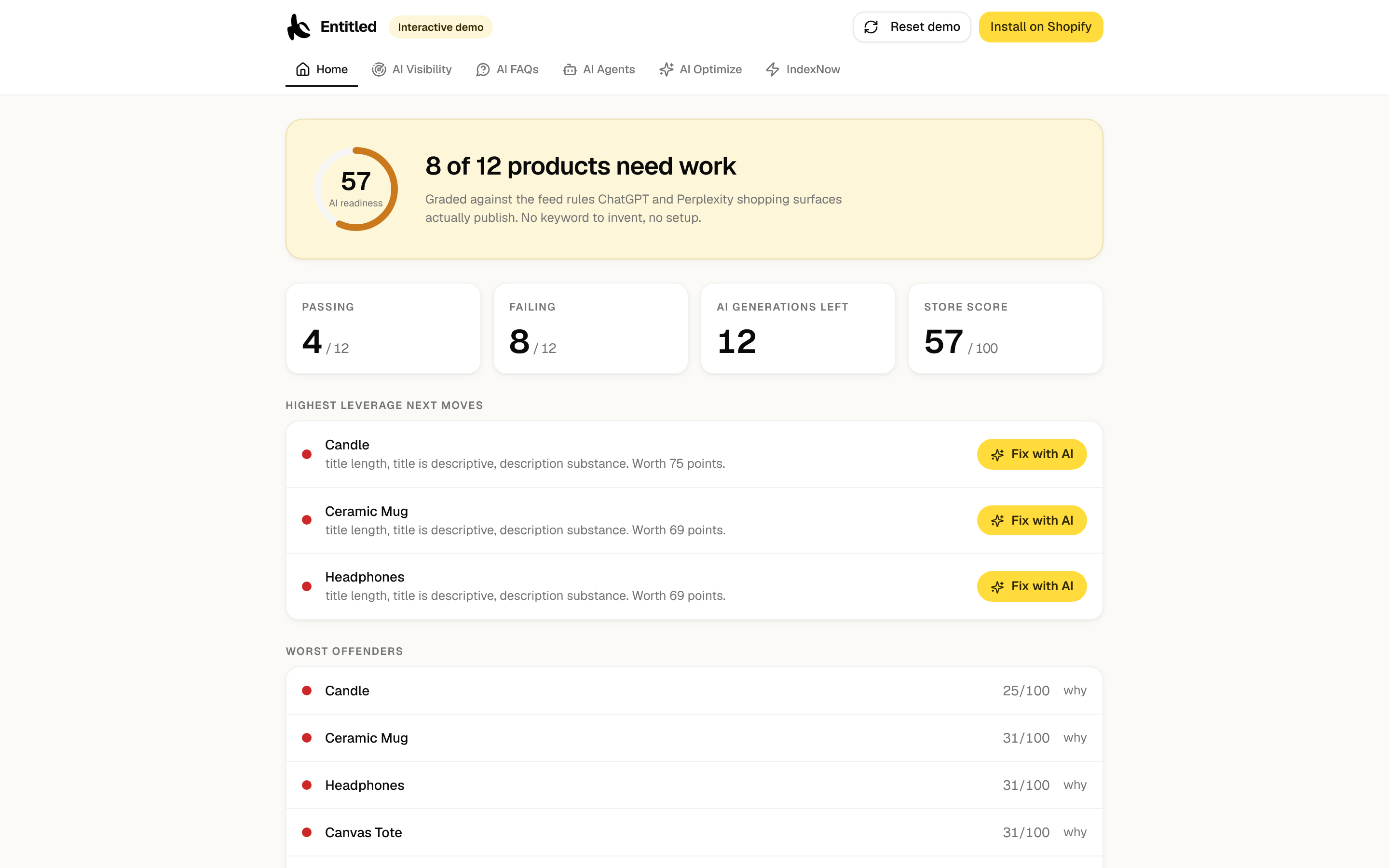
| 3. Be detailed | Titles, descriptions and attributes that state the facts a shopper asks about | Feed rules or Entitled's free readiness score |
| 4. Be citable | Pages and third-party mentions that answer real questions with specifics | Search your category questions in Perplexity and read the citations |
| 5. Measure the trend | A fixed prompt set, asked repeatedly, read over weeks | The AI visibility audit |
What Perplexity says decides the answer
Perplexity publishes less about ranking than Google does, but what it does say is specific. Read on 22 November 2026, its Instant Buy help article makes three statements that matter to a merchant. Its answer engine ranks sources based on authority and relevance. Product listings are not sponsored: its algorithm determines all of them based on relevance and ratings. And the engine is more likely to recommend merchants who provide deeper product details.
Its Pro Search article adds how the answer is assembled: Pro Search can run several searches, read the results and combine them into one answer that cites its sources. Its November 2025 shopping post, which relaunched shopping with PayPal-powered checkout for all US users, says product cards focus on what matters for the specific question asked. That is a company describing its own product, so read it as intent rather than proof.
Put together, the list is short and mostly operational. Relevance to the exact question, ratings, depth of product detail, and the authority of the page being cited. Nothing on it can be bought, and nothing on it rewards repeating a keyword. Everything below maps to one of those four.
Step 1: let PerplexityBot in
Perplexity's bot documentation, read on 22 November 2026, describes two agents. PerplexityBot is designed to surface and link websites in Perplexity's search results, and the page says it is not used to crawl content for AI foundation models. Perplexity-User visits a page when a user's question needs it, and because a user requested the fetch, Perplexity says it generally ignores robots.txt rules.
So the agent that decides whether your pages can be cited from Perplexity's own index is PerplexityBot, and blocking it costs you citations while buying nothing on training. The common failure on Shopify is not robots.txt at all but a CDN or bot-protection layer that challenges unknown crawlers. Perplexity notes robots.txt changes can take up to 24 hours to apply, and firewall changes may take longer. Our crawler checklist covers how to test both layers, and the robots.txt template shows the exact lines.
Step 2: be in the product index
Product cards draw on Perplexity's product index, not only on crawled pages. For a Shopify store the path in is Shopify's integration, which Shopify described on its own blog in April 2026; it is not a feed you upload. Perplexity's merchant programme is a separate interest form that its launch post aimed at large retailers. Filling it in costs minutes and is worth doing, but your eligibility does not depend on it. We cover the programme and the four routes in in detail.
Checkout inside Perplexity is Instant Buy. Its help page says the service is available to users in the United States, excluding Enterprise Pro and Enterprise Max plans, and only with merchants compatible with its agentic checkout. If you sell to the US and want to be buyable, not just visible, read the Instant Buy page. If you do not, visibility still works: the card links to your store.
Step 3: give the engine deeper product details
This is the lever Perplexity names outright, and it is fully in your hands. A shopper does not ask Perplexity for a blanket. They ask for a machine-washable wool throw under 150 dollars that will not itch. An engine matching that question to products needs the material, the care instructions, the size and the price stated in your data, in words, not implied by a photo.
Here is a worked example from the kind of catalog we score every day. The product exists, it is good, and as written it cannot answer the question above.
| Field | Before | After |
|---|---|---|
| Title | The Cosy Throw | Merino Wool Throw Blanket, 130 x 170 cm, Machine Washable, Oatmeal |
| Description opening | Our favourite way to curl up this winter. | A 130 x 170 cm throw woven from 100% merino wool, machine washable on a 30 degree wool cycle and soft enough to use against bare skin. |
| Attributes | None set | Material: merino wool. Size: 130 x 170 cm. Care: machine wash 30 degrees. Colour: oatmeal. |
| Questions it can now answer | None of size, material, care or itch | Wool or acrylic, how big, can it go in the washer, is it soft |
Step 4: be a source worth citing
Perplexity ranks sources on authority and relevance, and it shows its work: every citation is a link you can open. That makes Perplexity unusually easy to study. Ask it ten questions your customers ask, open the citations, and you will see which kinds of pages it leans on in your category: brand sites, review sites, retailer pages, forums, comparison guides.
Then be on those pages honestly. On your own store that means answering the questions shoppers ask in plain text: care, sizing, materials, shipping times, what the product is not good for. Off your store it means reviews and ratings, which Perplexity names for product listings, and genuine mentions in the places it already cites. The mention research we track points the same way: an Ahrefs study of 75,000 brands found branded web mentions the strongest correlate of appearing in AI answers. That is correlation, not a recipe, and we label it so.
Step 5: measure the rate, not a position
Perplexity links every citation, so it is one of the few assistants that can send you a measurable click. Referrals from perplexity.ai show up in analytics, and GA4 now has a channel for AI assistants. That is the cleanest signal you will get from any answer engine.
For mentions, the method is the same as for ChatGPT. Write 20 to 50 questions a real shopper in your category would ask, ask them repeatedly over weeks, and track how often your store is cited or carded. Published research found answers to the same prompt sharing well under half of their sources from one day to the next, which is why a single test proves nothing. Read the trend.
What does not work
Paying for placement. Perplexity says its product listings are not sponsored and are determined by relevance and ratings. A vendor promising guaranteed Perplexity placement is selling something Perplexity says does not exist.
Keyword stuffing, and buying a feed spec. Perplexity has never published a product feed field specification; the lists circulating are Google's spec relabelled. Blocking PerplexityBot to protect your content from training also fails on its own terms, since Perplexity says that crawler is not used for training. Entitled cannot promise you a Perplexity mention either. What it does is score and fix the product detail Perplexity says it rewards, for $4.99 a month, and show you the trend.
Frequently asked questions
How do I rank in Perplexity?
Work five levers in order: allow PerplexityBot through robots.txt and your CDN, keep your Shopify catalog flowing into Perplexity's product index, make product titles and descriptions detailed enough to answer a shopper's constraints, earn ratings and mentions on pages Perplexity cites, and measure how often you are cited across many prompts over weeks.
Can I pay Perplexity to recommend my products?
No. Perplexity's help centre says its product listings are not sponsored and that its algorithm determines them based on relevance and ratings. It also says merchants who provide deeper product details are more likely to be recommended.
Does blocking PerplexityBot stop Perplexity training on my site?
Perplexity says PerplexityBot is not used to crawl content for AI foundation models, so blocking it does not change training. It does remove your pages from being surfaced and linked in Perplexity's results.
Is Perplexity SEO different from Google SEO?
The basics overlap: crawlable pages, clear answers, authority. The differences are that Perplexity cites several sources per answer rather than ranking ten links, personalises recommendations using a user's past searches, and for shopping draws on a product index fed by platform integrations such as Shopify's.
How long does it take to show up in Perplexity?
Perplexity says robots.txt changes can take up to 24 hours to apply. Product data changes depend on how quickly the integration resyncs and the page is recrawled. Mention rates move over weeks, so measure monthly rather than daily.
Sources
- Perplexity Help: What is Instant Buy?
- Perplexity Help: what is Pro Search?
- Perplexity: Shopping That Puts You First, 25 Nov 2025
- Perplexity: PerplexityBot documentation
- Perplexity: Shop like a Pro, 18 Nov 2024
- Shopify blog: Perplexity shopping for merchants (2 Apr 2026)
- Ahrefs: AI brand visibility correlations, 75,000 brands
Keep reading
Score your own catalog
Entitled grades every product against the rules on this page, explains each failure, and fixes them with AI you approve. The score is free forever.