
AI visibility and AEO fundamentals for Shopify stores
AI visibility is how often AI assistants such as ChatGPT, Perplexity, Claude and Google's AI surfaces name or cite your store when shoppers ask questions in your category. It is a rate across many prompts, not a rank. For a Shopify store it rests on four inputs: being in the product feeds, being crawlable, product data detailed enough to answer a question, and third-party evidence.
- Start here
AEO for Shopify: what answer engine optimization actually involves
Answer engine optimization for Shopify stores: how ChatGPT and Perplexity read your product data, what actually changes your odds, and what is marketing noise.
Answer engine optimization (AEO): what it is, how it works, and what has evidence
Answer engine optimization explained: how ChatGPT, Perplexity and Google AI pick sources, which AEO tactics have evidence, and how to measure it honestly.
SEO vs AEO: what carries over, and what actually changed
AEO is not a replacement for SEO and not a rebrand of it. What transfers directly, what changed shape, and the one new thing that has no SEO equivalent.
Does SEO still matter now that everyone asks ChatGPT?
Clicks are down and assistants are up, but AI answers are built from crawled pages and feeds. Why SEO fundamentals became AEO prerequisites, not casualties.
Does llms.txt do anything for a Shopify store?
Google says it ignores llms.txt. Ahrefs found 97% of published files got zero requests. Shopify serves one by default. The evidence, and what to do instead.
IndexNow for Shopify: what it does, and what it does not
IndexNow pushes changed URLs to Bing, Yandex, Naver, Seznam and Yep. Google does not participate. Why it still matters for AI search, and how to use it.
What AI visibility means for a store
AI visibility is the share of relevant questions in which an AI assistant mentions your store, cites one of your pages, or shows one of your products. Ask ChatGPT, Perplexity or Google's AI Mode for the best merino throw blanket under 150 dollars, and either your store is in the answer or it is not. Ask fifty such questions, and the fraction you appear in is your AI visibility for that category.
Three different things get called AI visibility, and it helps to keep them apart. Being listed means your products are in the feed an assistant draws on, which for most Shopify stores happens by default. Being cited means a page of yours is one of the sources linked under an answer. Being recommended means the assistant names you as an answer to the shopper's question. Listed and recommended are different problems with different fixes.
Answer engine optimization, AEO, is the work of raising that rate. For a publisher it is mostly about being quotable. For a Shopify store it is narrower and more mechanical: AEO for Shopify is mostly product data quality, and the general version explains how answer engines pick sources.
How AI visibility is measured
There is no rank tracker for AI answers, because there is no fixed result page. Every answer is generated fresh and shaped by the asker's context. What you can measure is a set of rates and counts, each with a known weakness.
| Measure | What it counts | The catch |
|---|---|---|
| Mention rate | Answers naming your store, over prompts asked | Varies run to run; read it as a trend over weeks |
| Citation rate | Answers linking one of your pages as a source | Only some assistants show sources consistently |
| AI referral sessions | Visits arriving from assistants, in GA4's AI Assistant channel since May 2026 | Counts clicks, not mentions; many answers send none |
| Readiness score | Products whose data passes the published feed rules | Measures the input you control, not the outcome |
Why a single check proves nothing
The same prompt, asked again, comes back with different sources. A 2026 academic study measured day-to-day source similarity of 0.34 to 0.42 for repeated prompts, meaning most of the cited sources changed from one day to the next. ChatGPT also personalises answers using memory, so the answer in your own account is not the answer a stranger gets.
That is why AI visibility is a sample, not a reading. Fix the prompt set, ask it repeatedly, and compare months, not mornings. AI share of voice is directional sets out the published variance numbers, and the one-hour audit is the manual method.
A worked example
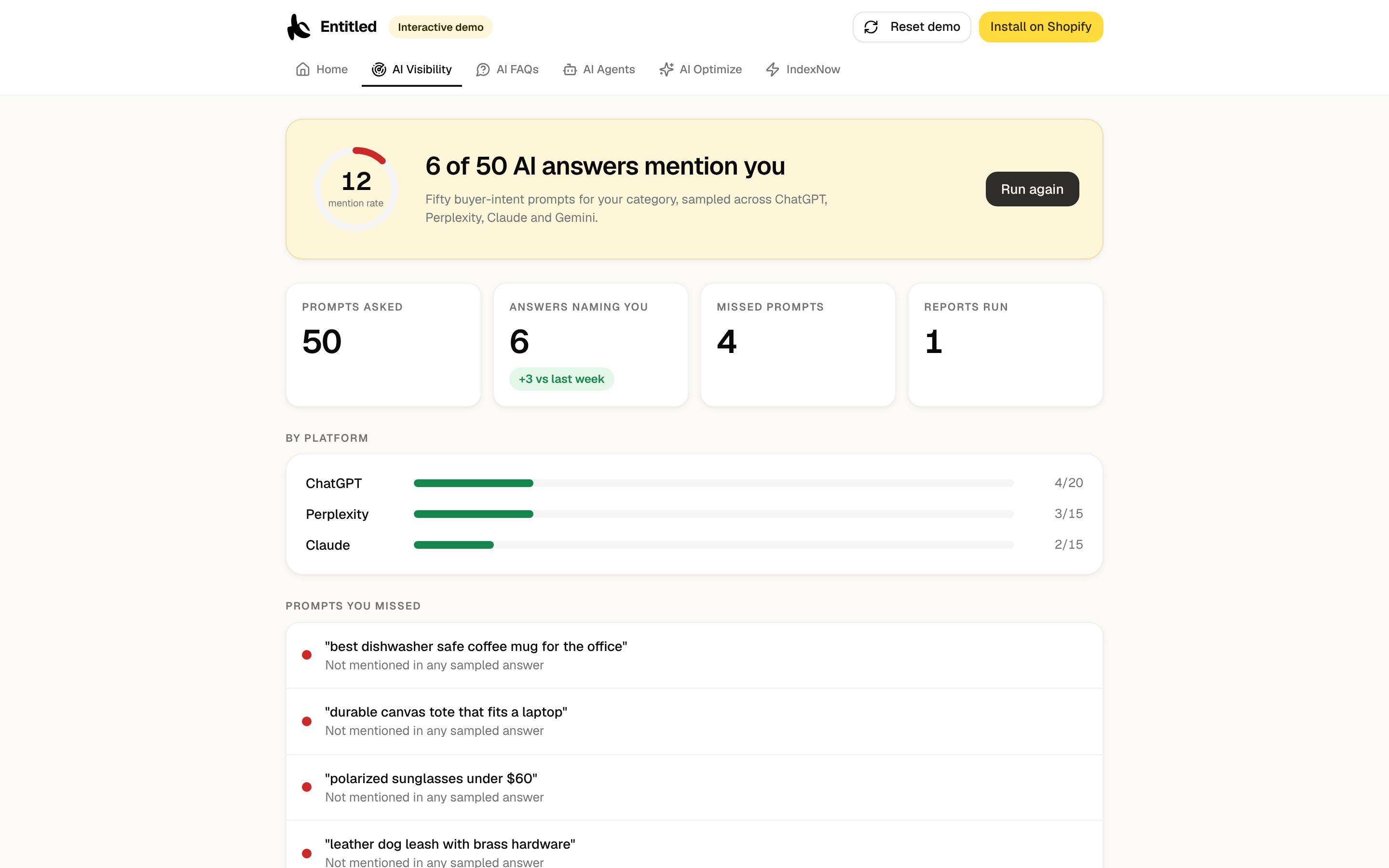
Take the sample store in Entitled's interactive demo, which sells mugs, totes, sunglasses and pet leashes. Fifty buyer-intent prompts for its categories are sampled across ChatGPT, Perplexity, Claude and Gemini. The store is named in 6 of the 50 answers, a 12% mention rate, up 3 answers on the week before. The split by platform shows where it lands most often, and the list of missed prompts shows where it never appears: questions like best dishwasher safe coffee mug for the office, or durable canvas tote that fits a laptop.
That last part is the useful one. A mention rate on its own is a scoreboard. A missed prompt about a dishwasher safe mug is a prompt to check whether the mug's title and description say dishwasher safe at all. The missed prompts tell you which facts to add to which products, and the next month's rate tells you whether it helped. Neither number is a promise: no tool can guarantee an assistant will name you.
The four inputs a Shopify store controls
Most of what decides AI visibility sits outside your store. Four inputs sit inside it, and they come in order.
- Presence. Shopify syndicates eligible products to ChatGPT and other AI channels through Catalog and agentic storefronts, on by default. Check you meet the published requirements rather than buying a connector.
- Access. The search and user-fetch crawlers, OAI-SearchBot, PerplexityBot and their siblings, must reach your pages through robots.txt and any CDN rule. Which bots to allow.
- Detail. Titles, descriptions and attributes that state material, size, use and price in words, inside the limits the surfaces publish, such as OpenAI's 150-character title maximum. The feed rules.
- Evidence. Reviews, ratings and mentions on the sites assistants already cite. Ahrefs' study of 75,000 brands found branded web mentions the strongest correlate of appearing in AI answers, a correlation it says is not proof of cause.
What AI visibility is not
It is not for sale. OpenAI states ChatGPT's product results are selected independently and are not ads, and Perplexity's help centre says its product listings are not sponsored. Anyone selling guaranteed placement is selling something the platforms say does not exist.
It is also not a replacement for SEO. Assistants build many answers from crawled pages and search indexes, so the SEO you already do still matters, and SEO and AEO overlap more than they differ. The fastest honest start is to check your store for free, then fix the products that fail.
Questions people ask
What is AI visibility?
AI visibility is how often AI assistants such as ChatGPT, Perplexity, Claude and Google's AI surfaces mention your brand, cite your pages or show your products when people ask questions in your category. It is measured as a rate across many prompts, because answers change from run to run.
How do I check my store's AI visibility?
Write 20 to 50 questions a real shopper in your category would ask, ask them in several assistants, and count how often your store is named. Repeat monthly and compare. The free AI visibility check samples this for you, and the AI visibility audit is the manual method.
How do I improve AI visibility for a Shopify store?
Work the four inputs in order: make sure products are eligible for Shopify Catalog, let the AI search crawlers reach your pages, make product titles and descriptions state the facts shoppers ask about, and earn reviews and mentions on sites assistants cite. Then measure the trend.
Is AI visibility the same as AEO?
No. AI visibility is the outcome, how often you appear in AI answers. Answer engine optimization (AEO) is the work done to raise it. GEO, generative engine optimization, is another name for much the same work.
Can I pay to increase my AI visibility?
Not in organic answers. OpenAI says ChatGPT product results are not ads and Perplexity says its product listings are not sponsored. ChatGPT does sell clearly labelled ads, which are separate from the answers themselves.
Last reviewed